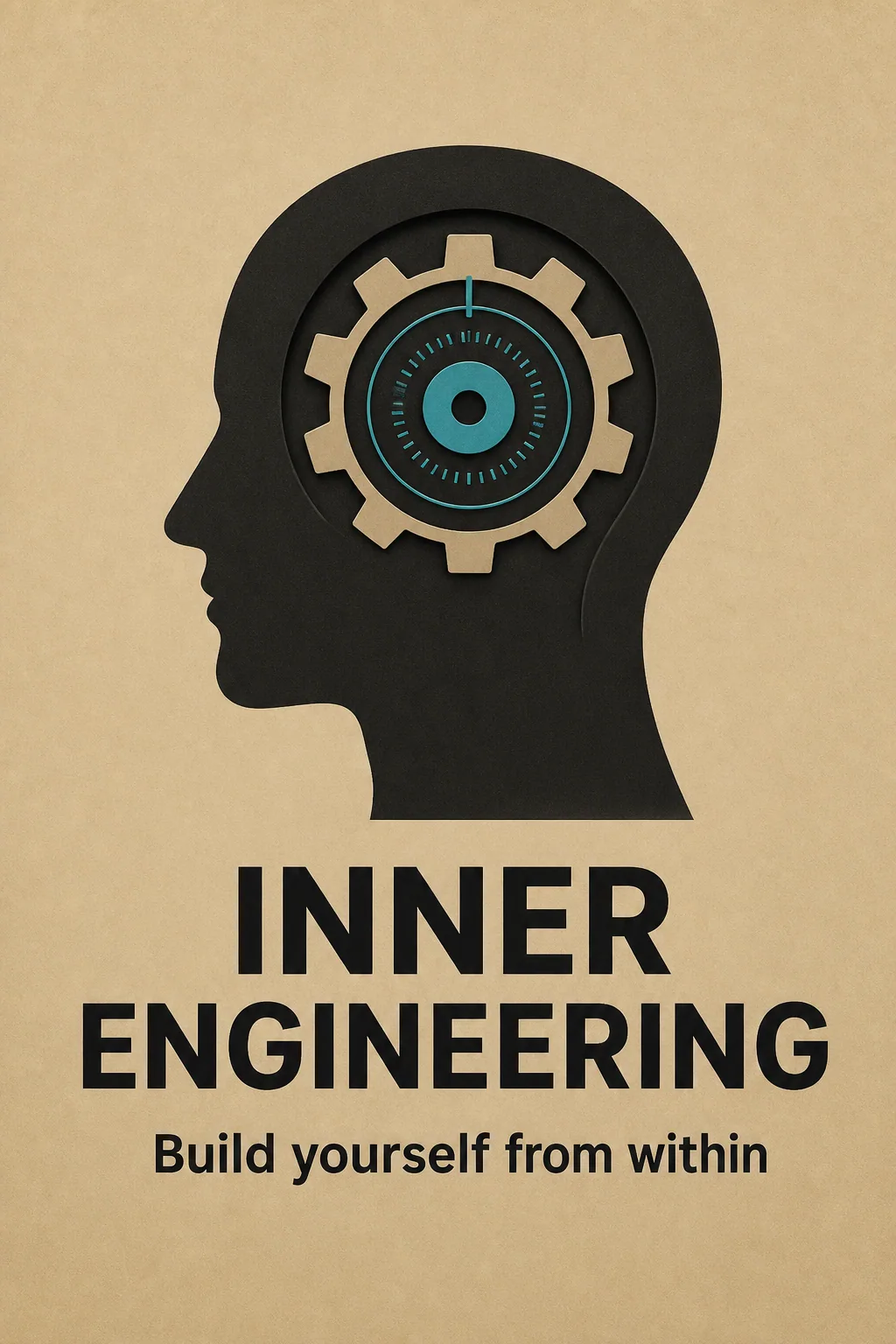
Inner Engineering

Inner Engineering Summary

A Yogi's Guide to Joy

by Sadhguru

  • 12 min read
  • Published 2016
  • 8 takeaways

Your mood should not be a public utility anyone can switch on and off. Inner Engineering reframes yoga as inner mechanics: a way to stop handing the control panel to traffic, memory, hunger, and every passing notification.

What you'll learn
  • Why experience starts within
  • How to create distance from thought
  • The body as inner wiring
  • Karma without cosmic courtroom drama
  • Responsibility as response ability

Key point 1

The switches were never outside

A driver cuts you off, and suddenly your whole inner weather changes lanes with him.

Sadhguru, born Jaggi Vasudev, writes as a yogi with the mind of a systems tinkerer. His angle is simple and bold: most people live as if their joy, anger, and peace are controlled by events outside them, while yoga is the craft of moving that control panel inward.

The concrete claim of Inner Engineering is that every human experience happens within you, even when the trigger comes from outside. If you learn to work with body, mind, emotion, and energy, well-being stops being a lucky visitor and becomes a skill.

A thermostat is a poor life coach.

The book asks a sharp question with soft robes on: who is actually touching the switches?

Key point 2

A mountain moment becomes a manual

On Chamundi Hill in Mysore, in 1982, Jaggi Vasudev says he sat on a rock and felt his usual sense of self disappear for hours.

That experience becomes the seed of Inner Engineering. Sadhguru is not trying to sell calm as a mood upgrade. He is trying to describe a change in where you place your identity.

Most of the book rests on one claim: you are tangled with what you have gathered. Your body is built from food. Your mind is filled with impressions. Your name, job, taste, fears, and opinions were all collected after birth. When you mistake the collection for the collector, life becomes a storage room with a crown.

The problem is not that you have a body and a mind. The problem is that you let the tools wear the name tag.

This matters because modern self-help often treats distress as a bad setting to adjust. Sadhguru goes below the setting. He asks whether the person turning the knob knows they are separate from the knob.

Yoga, in his use, means union, but not a vague hug with the universe. It means seeing life as one process rather than a pile of separate, worried parts. If that sounds grand, the practical point is plain: a little distance from your body and thoughts gives you room to respond.

The mind is a brilliant clerk with a stamp pad and no taste.

Once you see the clerk as a clerk, the workshop changes. You stop worshiping every noise from the bench.

Key takeaways

Key point 3

The mind keeps pulling old levers

Key point 4

The body votes before the speech

Key point 5

Karma is the groove, not the judge

Key point 6

Responsibility has edges

Key point 7

The panel becomes a place to stand

Key point 8

Try this

Continue reading the full book summary and unlock all remaining key takeaways.

Get full summary

About the author

Sadhguru

Sadhguru, born Jaggi Vasudev, is an Indian yogi, teacher, and founder of the Isha Foundation, a nonprofit organization built around yoga, meditation, and inner transformation. His authority here comes less from academic credentialing than from decades of teaching embodied practices to millions of people — plus a talent for turning ancient yogic ideas into sharp, usable machinery.

Related topics

Want to keep reading this summary?

Get full access to complete summaries and audio versions in one place.

Continue to onboarding

Related books

Keep learning with similar reads

Unlock full library

Frequently asked questions