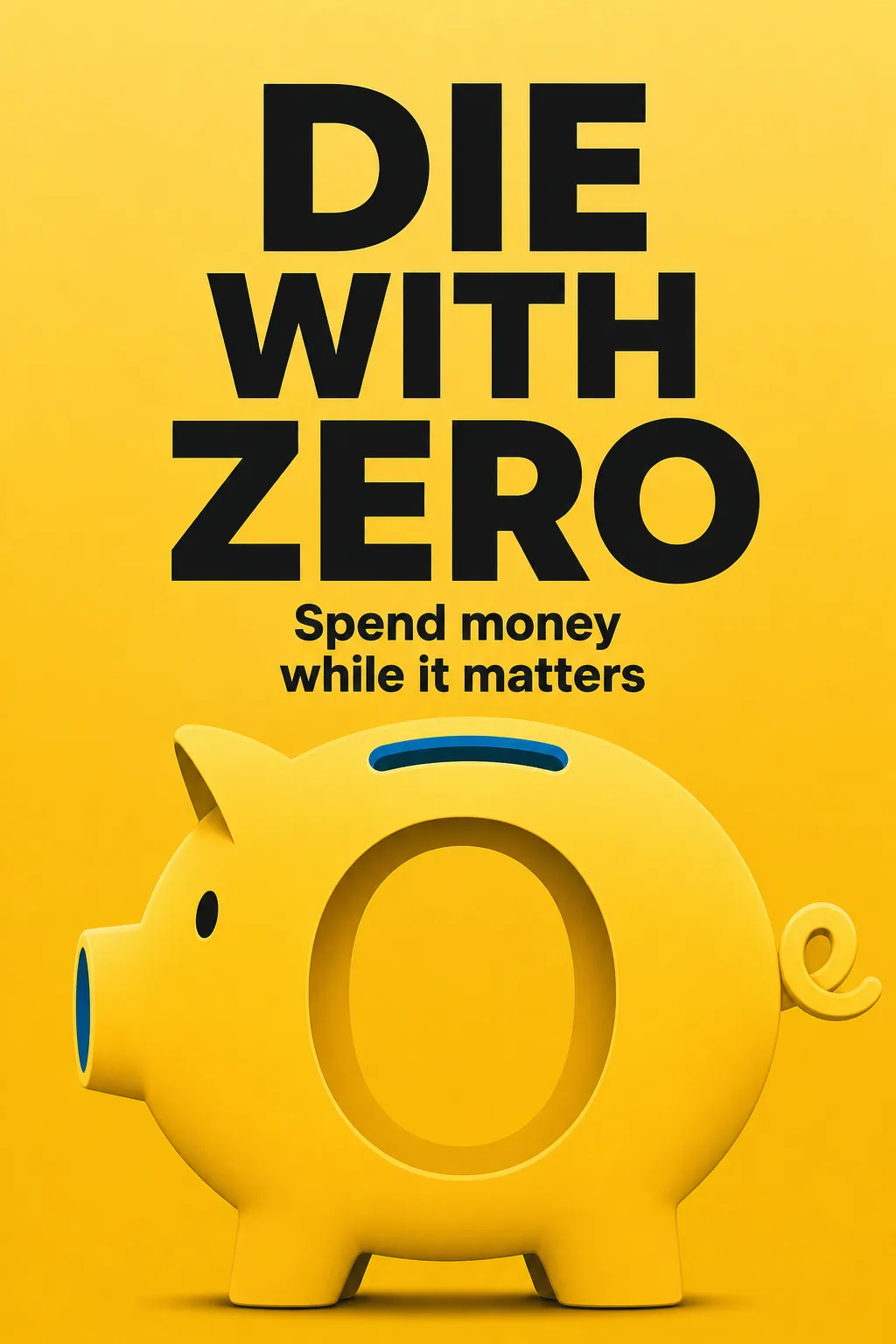
Die with Zero

Die with Zero Summary

Getting All You Can from Your Money and Your Life

by Bill Perkins

  • 12 min read
  • Published 2020
  • 8 takeaways

A bigger bank balance can still be a life poorly spent. Die with Zero asks the rude question most financial advice politely dodges: what is your money waiting for, and will your body, friends, and courage still be there when it arrives?

What you'll learn
  • Why money needs a deadline
  • How memory dividends work
  • The trap of late inheritance
  • When net worth should peak
  • Why zero is not literal

Key point 1

The fair closes before your pockets are empty

Near the end of a carnival day, the worst prize is a fistful of unused ride tickets.

Bill Perkins wants you to feel that small panic while you still have time to do something useful with it. Perkins is a hedge fund manager, film producer, poker player, and professional risk-taker who looks at personal finance from a strange angle. He does not ask how to die rich. He asks how not to waste the life that money was supposed to serve.

His core claim is blunt: money only has value when it buys lived experience, freedom, help for people you love, or time with a body that can still use it. A life can be under-lived even when the bank statement is very well behaved.

The book is not an excuse to be reckless. It is a demand to spend, give, and plan with the same care that people usually reserve for saving.

Key point 2

Experiences keep paying after the receipt fades

Daniel Kahneman spent years studying the split between the self that lives through a moment and the self that remembers it, and by the early 2000s he had made that split a central idea in psychology. Perkins builds his money advice on that same divide.

An experience is not over when it ends. A trip, dinner, concert, hard climb, or long talk can keep paying through memory, story, taste, confidence, and friendship. Perkins calls this a “memory dividend,” which is the book’s most useful idea. The ticket buys the ride once, but the mind keeps replaying it at odd hours, like a little cinema with terrible scheduling and surprisingly good taste.

Spend for the life you will remember, not only for the life you can afford.

This matters because most financial advice treats spending as the leak in the system. Perkins treats well-timed spending as the point of the system. If money becomes a bridge into a richer life, then the best purchase is not always the cheapest one. It is the one that grows in memory.

That does not mean every luxury counts. A dull upgrade bought to signal success gives a weak dividend. A hard, social, vivid, or once-in-a-season experience gives a stronger one. The difference is not price. The difference is whether the event becomes part of your inner furniture.

Unused money is applause you never heard.

Perkins is especially sharp on timing. The same trip taken at 28, 48, and 78 is not the same trip. Your knees, friends, appetite, and courage all charge different prices. Spend too late, and you may still have the cash, but the booth has changed the rules.

Key takeaways

Key point 3

Life has seasons, and money should know the weather

Key point 4

Your net worth should peak before your pulse stops

Key point 5

A gift arrives richer when it arrives early

Key point 6

The math cannot remove the fog

Key point 7

Count the rides, not the leftovers

Key point 8

Try this

Continue reading the full book summary and unlock all remaining key takeaways.

Get full summary

About the author

Bill Perkins

Bill Perkins is a hedge fund manager, energy trader, film producer, and high-stakes poker player — not exactly the résumé of someone allergic to risk. His authority comes from applying a trader’s eye for timing, odds, and opportunity cost to the most awkward asset class of all: a finite human life.

Related topics

Want to keep reading this summary?

Get full access to complete summaries and audio versions in one place.

Continue to onboarding

Related books

Keep learning with similar reads

Unlock full library

Frequently asked questions