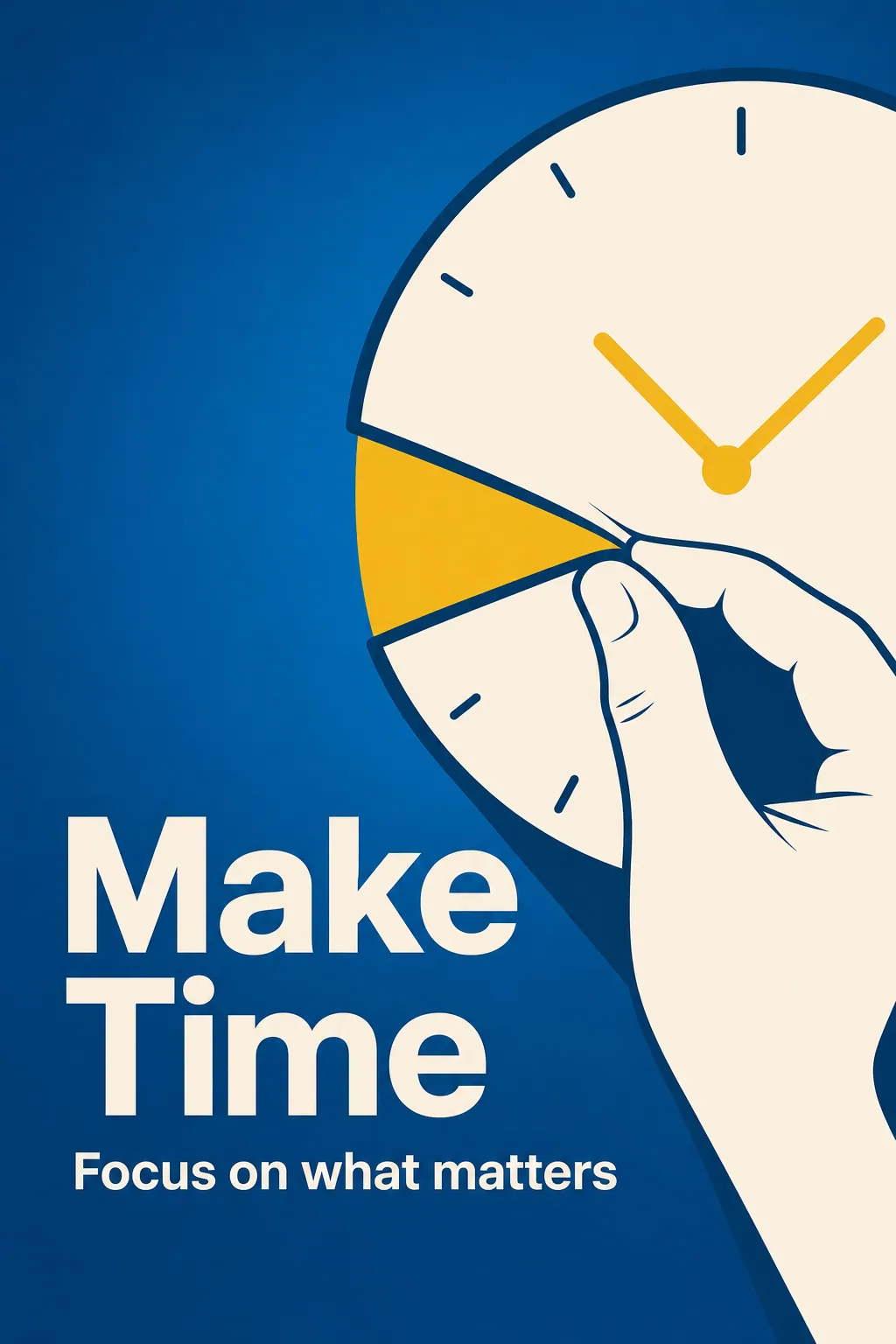
Make Time

Make Time Summary

How to Focus on What Matters Every Day

by Jake Knapp and John Zeratsky

  • 12 min read
  • Published 2018
  • 8 takeaways

Your day is not a container. It is a contested territory. Make Time shows how to defend one meaningful patch of it before apps, errands, and other people’s emergencies start charging rent.

What you'll learn
  • How to choose a daily Highlight
  • Why willpower is a bad bodyguard
  • Laser mode for distraction
  • Energy as attention’s budget
  • How to prototype a better day

Key point 1

A cleared square of counter

The modern day often arrives like a kitchen counter after a large dinner: messages, meetings, tabs, errands, and one sad banana nobody remembers buying.

Jake Knapp and John Zeratsky know that mess from the inside. Knapp helped build the Design Sprint method at Google Ventures, where teams tested big ideas in five days. Zeratsky worked on products like YouTube and later wrote about design, attention, and the traps designers set for the rest of us.

Their claim in Make Time is simple and useful: you do not need a perfect life system to protect one meaningful part of your day. You choose one Highlight, block the worst distractions, feed your energy, and learn from what happened.

Make Time is not a call to squeeze more tasks into the day. It is a way to clear enough space for the one thing you would hate to miss.

Key point 2

Pick the dish before the kitchen gets loud

Before email opens its mouth, the day is still soft.

Knapp and Zeratsky ask you to choose a daily Highlight, which means one activity that deserves the best part of your attention. It can be urgent, satisfying, or joyful, but it must be specific enough to put on a calendar. “Work on project” is fog. “Draft the first two pages of the proposal” has a handle.

A Highlight gives the day a main character before the crowd rushes in.

This idea grew out of Knapp’s work with teams at Google Ventures, where the Design Sprint became a five-day process for forcing one hard choice into view. The same design habit moves into personal life here. You stop treating the day as a bowl for whatever gets poured into it.

The point is not that everything else becomes unimportant. Bills still exist. Children still need shoes. A dentist appointment does not cancel itself because you discovered purpose before breakfast. The point is that a day without a chosen focus will borrow one from the loudest bidder.

Your calendar is a democracy with terrible voter turnout.

This matters because attention has become a public hunting ground. If you do not decide what matters by midmorning, other people’s systems decide for you. The Highlight gives you a small act of rule over your own time. It is modest, which is why it works. A grand life purpose can scare you into opening another tab. A ninety-minute Highlight can be started after coffee.

Key takeaways

Key point 3

Distraction wins by arriving dressed as convenience

Key point 4

Attention needs a body with fuel in it

Key point 5

A better day is built like a prototype

Key point 6

Not everyone owns the room they are asked to rearrange

Key point 7

The counter becomes a workbench

Key point 8

Try this

Continue reading the full book summary and unlock all remaining key takeaways.

Get full summary

About the author

Jake Knapp and John Zeratsky

Jake Knapp is a designer and author best known for creating the Google Ventures Design Sprint, a practical method for testing big ideas fast. John Zeratsky is a designer, writer, and former YouTube product lead, which gives him an unusually good view of the attention traps modern technology creates. Together, they write about time not as monks on a mountain, but as former builders of the machinery now tugging at your sleeve.

Related topics

Want to keep reading this summary?

Get full access to complete summaries and audio versions in one place.

Continue to onboarding

Related books

Keep learning with similar reads

Unlock full library

Frequently asked questions