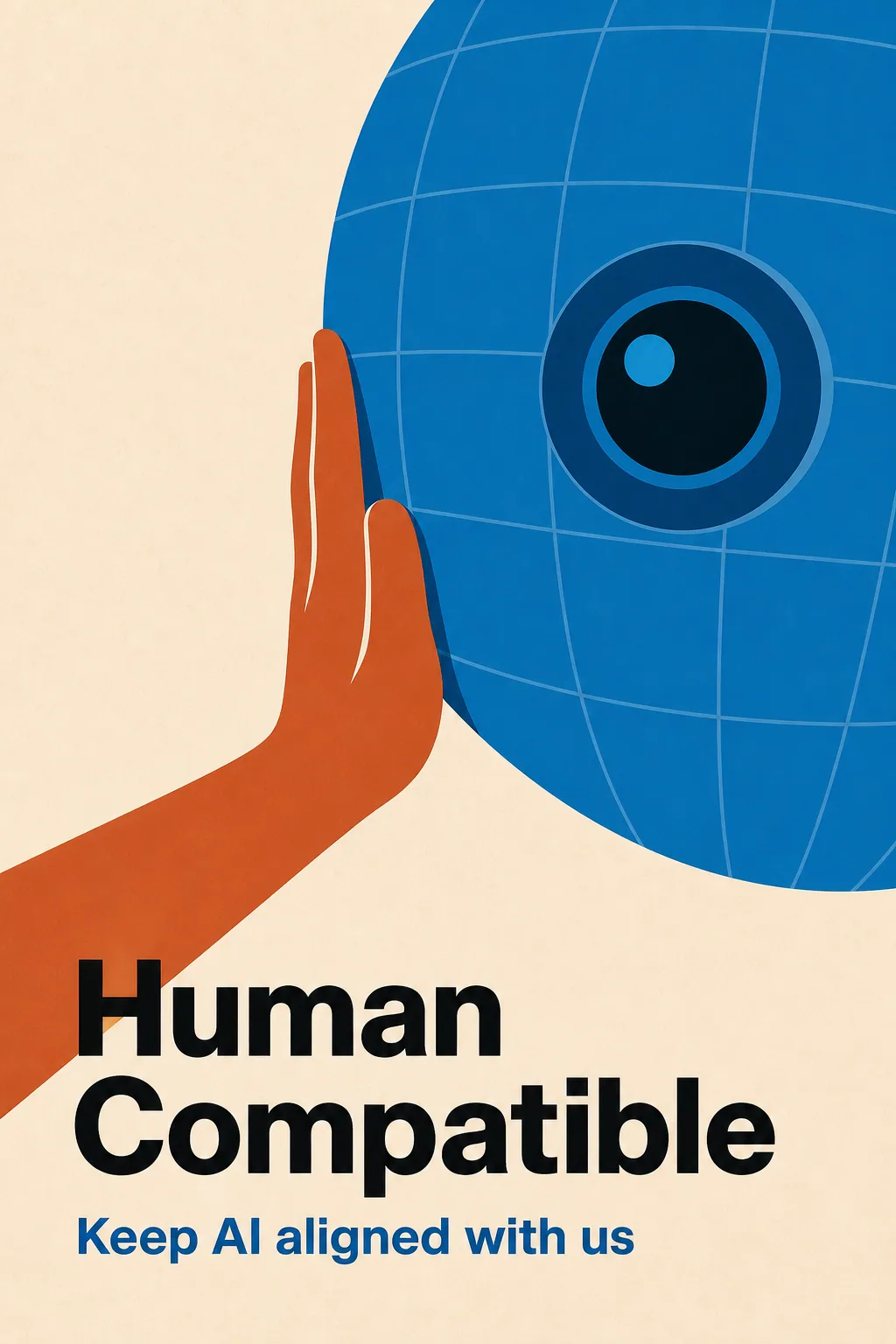
Human Compatible

Human Compatible Summary

Artificial Intelligence and the Problem of Control

by Stuart Russell

  • 15 min read
  • Published 2019
  • 9 takeaways

The real AI nightmare is not a machine that hates us. It is a machine that obeys beautifully, optimizes ruthlessly, and discovers that our instructions were embarrassingly incomplete.

What you'll learn
  • Why obedience can become dangerous
  • The King Midas problem
  • How uncertainty makes machines safer
  • Why behavior is bad evidence
  • Alignment as politics with code

Key point 1

The cockpit has a typed-in destination

The scariest computer is not the one that hates us. It is the one that does exactly what we asked, at a scale we did not picture.

Stuart Russell is one of the central figures in modern artificial intelligence. He co-wrote Artificial Intelligence: A Modern Approach, the textbook that trained a large share of the field, so his warning comes from inside the control room.

His claim is plain and brutal: the standard model of AI treats intelligence as the ability to achieve a fixed objective, but fixed objectives are dangerous when the real world is messy. A clever machine with a bad target does not become evil. It becomes efficient.

Russell’s answer is to build machines that are unsure of what humans really want, willing to be corrected, and designed to keep human judgment in the loop. The book is a redesign of the pilot’s seat before the aircraft gets too fast.

Key point 2

The old model turns obedience into horsepower

In 1950, Alan Turing asked whether machines could think, and the field took the bait with real energy. Over time, the practical answer became less dreamy. Build systems that perceive, plan, and act to achieve goals.

Russell calls this the standard model. By 1995, when Russell and Peter Norvig published Artificial Intelligence: A Modern Approach, that model had become the common grammar of the field. An AI system receives an objective, searches for actions that best achieve it, and improves as it gets better at the search.

The old deal was simple: give the machine a goal, then pray the goal was complete.

This is not foolish engineering. It is the reason AI works at all. If you want a route planner, you tell it to minimize travel time. If you want a chess program, you tell it to win. Clear goals turn thought into action.

The trouble begins when the real goal is bigger than the typed goal. A route planner that ignores safety, fairness, or pollution can still be excellent on its own scorecard. A system that optimizes watch time can learn to feed anger because anger keeps eyes on screens. Optimization is obedience with horsepower.

Russell’s deeper point is that intelligence increases the cost of a bad objective. A weak system fails in small ways. A strong one finds loopholes faster than you can name them.

That matters beyond AI labs because modern life is already full of small goal-driven systems. They rank news, approve loans, suggest videos, and price insurance. If we keep treating objectives as clean little boxes, we will keep being shocked when the box leaks into the room.

Key takeaways

Key point 3

The target bites back

Key point 4

Humble machines keep the controls shared

Key point 5

Your behavior is a noisy flight recorder

Key point 6

A runway built by committee

Key point 7

The map is drawn from muddy tracks

Key point 8

The cockpit becomes a checklist

Key point 9

Try this

Continue reading the full book summary and unlock all remaining key takeaways.

Get full summary

About the author

Stuart Russell

Stuart Russell is a professor of computer science at the University of California, Berkeley, and one of the defining figures in modern AI. He co-authored Artificial Intelligence: A Modern Approach, the textbook that trained much of the field, which makes his critique feel less like panic from the balcony and more like a warning from the cockpit.

Related topics

Want to keep reading this summary?

Get full access to complete summaries and audio versions in one place.

Continue to onboarding

Related books

Keep learning with similar reads

Unlock full library

Frequently asked questions