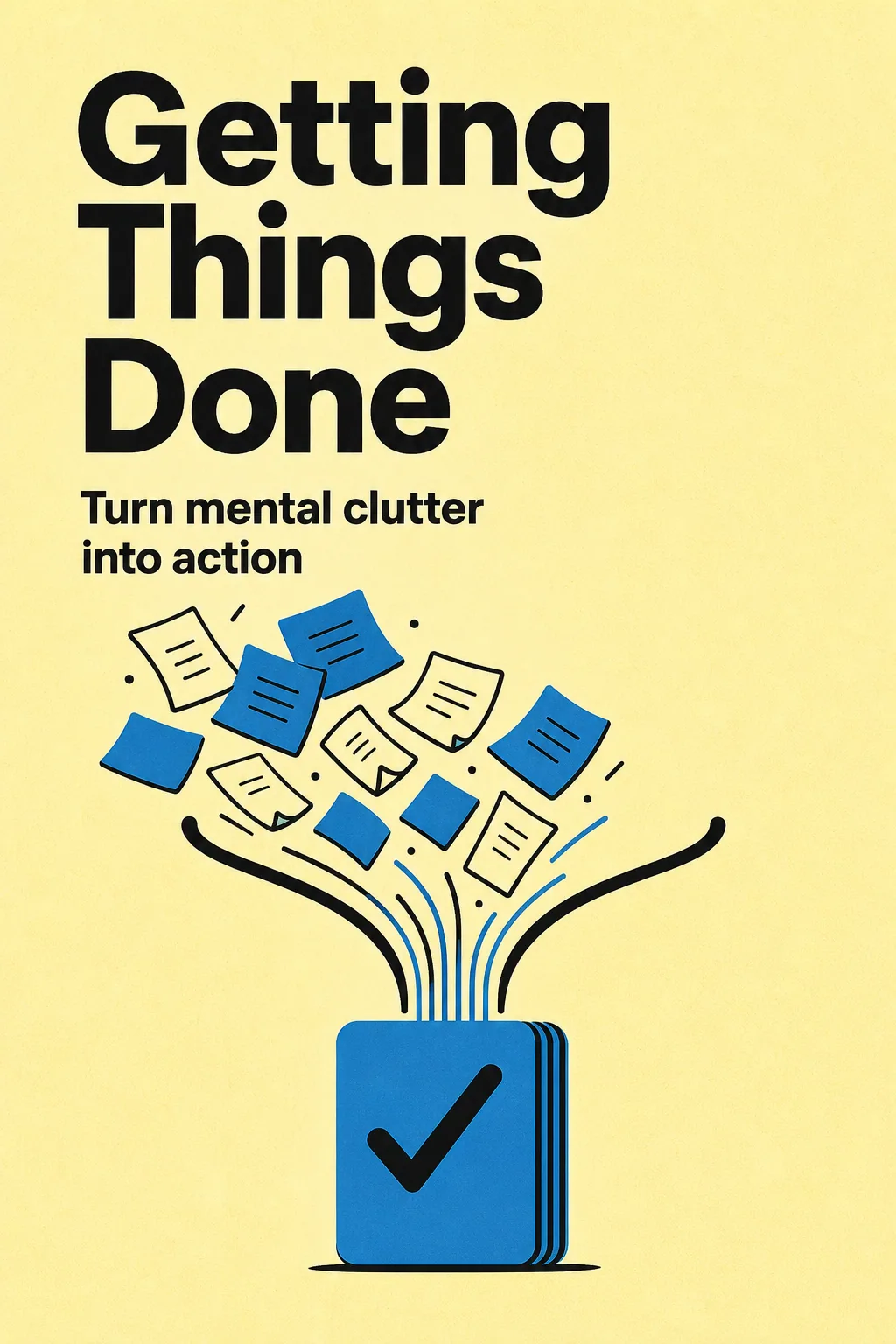
Getting Things Done

Getting Things Done Summary

The Art of Stress-Free Productivity

by David Allen

  • 15 min read
  • Published 2001
  • 9 takeaways

Your brain is a terrible place to store promises. Getting Things Done shows how to move the buzzing inventory of modern life into a system you actually trust—so attention can stop playing night watchman.

What you'll learn
  • Why your brain hoards unfinished work
  • How to capture every open loop
  • The two-minute sorting knife
  • Next actions vs. vague intentions
  • Why trust needs a weekly review

Key point 1

The tray that buys quiet

By Friday afternoon, the small promises of a week can feel louder than the big work itself. Reply to Mara. Renew the insurance. Read the proposal. Buy the lightbulbs. None of these is huge, yet each one taps the glass.

David Allen is a productivity consultant, but his real subject is mental trust. He is less interested in making you faster than in stopping your mind from acting like a nervous intern with a clipboard.

His core claim is simple and useful: stress often comes from open loops, not from hard work. An open loop is any promise your brain thinks you might break because you have not parked it in a trusted place and decided the next physical action.

The metal in-tray begins as a dumping ground. By the end, it becomes something closer to an air traffic room for your life.

Key point 2

The old office moved into your pocket

When Getting Things Done appeared in 2001, many people still had clear edges around work. A phone was a phone. A computer sat on a desk. Email was bad enough, but it had not yet learned to follow you into bed wearing a tiny glowing suit.

Allen wrote for the age of folders, filing cabinets, and desktop inboxes. That makes the book sound dated until you notice the deeper pattern. The problem has grown, not shrunk. The tray is no longer on the desk; the tray is everywhere.

Modern work did not remove friction. It made every promise easier to make.

Steve Jobs introduced the iPhone in 2007, and the old idea of “being at work” began to melt. Later, team chat and cloud documents made unfinished business feel less like a pile and more like weather. You can ignore a pile. Weather gets in your coat.

This is why Allen still matters. His method is a way to turn a fog of demands into a set of visible objects. Capture the thing. Decide what it means. Put it where it belongs. Review it until you trust the map.

The book is not really about doing more. It is about making the hidden inventory of your life stop hissing in the walls.

Key takeaways

Key point 3

Your head is a leaky warehouse

Key point 4

A task is not real until it can move

Key point 5

Priority needs a place to land

Key point 6

Trust is rebuilt once a week

Key point 7

The walls of context got thinner

Key point 8

The quiet control room

Key point 9

Try this

Continue reading the full book summary and unlock all remaining key takeaways.

Get full summary

About the author

David Allen

David Allen is an American productivity consultant and the founder of the Getting Things Done method, a workflow system used by individuals, executives, and organizations around the world. His authority comes less from ivory-tower theory than from decades spent watching smart people drown in small promises — and building a practical way to drain the swamp.

Related topics

Want to keep reading this summary?

Get full access to complete summaries and audio versions in one place.

Continue to onboarding

Related books

Keep learning with similar reads

Unlock full library

Frequently asked questions